Introduction
GeoAnalyze is a Python package designed to streamline geoprocessing by handling internal complexities and intermediate steps. Conceptualized and launched on October 10, 2024, this package is tailored for users with limited geospatial processing experience, allowing them to focus on desired outputs. Leveraging open-source geospatial Python modules, GeoAnalyze aims to empower users by providing high-level geoprocessing tools with fewer lines of code. This fast package is also useful for the users who has no access of paid GIS software packages.
Wateshed Delineation
The GeoAnalyze.Watershed and GeoAnalyze.Stream classes provide fast and scalable watershed delineation functions by leveraging the computational efficiency of the PyPI package pyflwdir, without requiring a detailed understanding of it. These functions can be executed either individually or simultaneously.
Hydrology
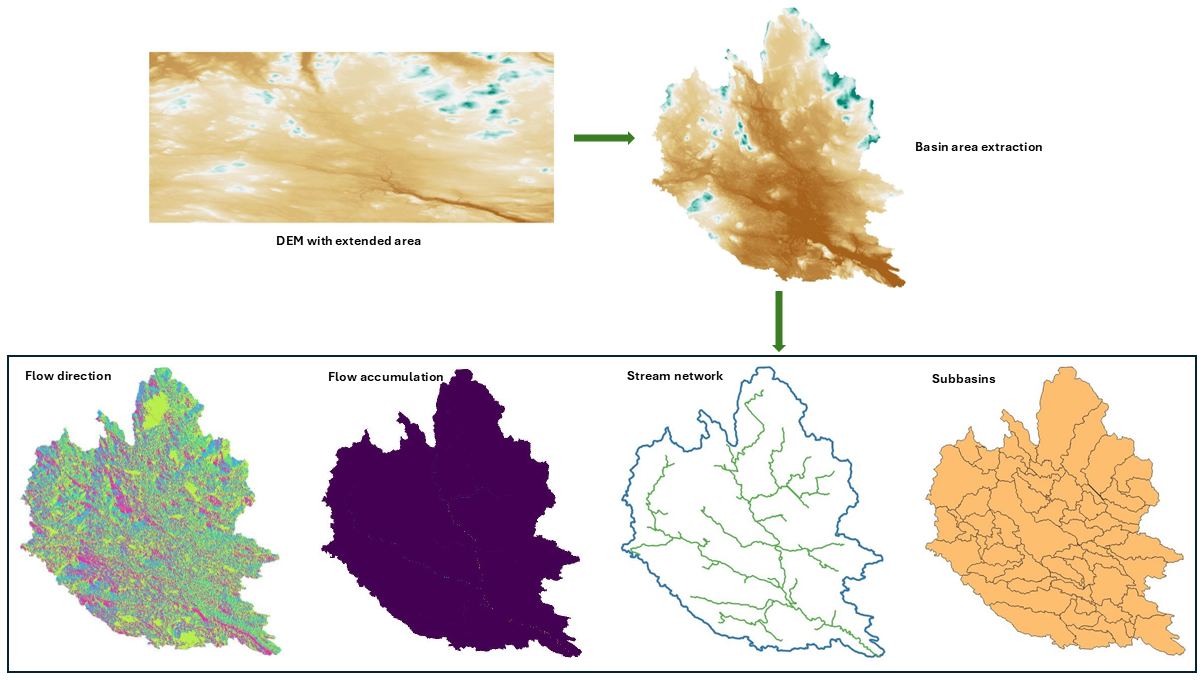
Basin area extraction from an extended Digital Elevation Model (DEM)
DEM pit filling
Slope calculation
Slope classification
Aspect determination
Flow direction mapping
Flow accumulation computation
Stream extraction
Subbasin generation
The computational efficiency of these functions is demonstrated in the following output figure. All delineation files—including basin area, flow direction, flow accumulation, slope, stream, outlets, and subbasins—can be generated within 30 seconds from a raster containing 14 million cells. Please refer to the Watershed Delineation section or more details.
Stream Network
Determines the adjacent downstream segment for each stream segment
Retrieves adjacent upstream segments associated with each stream segment
Builds full connectivity structures from upstream to downstream
Computes connectivity structures from downstream to upstream
Removes all upstream connectivity up to headwaters for targeted stream segments
Merges stream segments either between two junction points or from a junction point upstream until a headwater is reached
Detects junctions, drainage points, main outlets, and headwaters within the stream network
Computes Strahler and Shreve orders of stream segments
Includes multiple functions for generating random boxes around selected stream segments
Geoprocessing
The GeoAnalyze package leverages the existing PyPI packages, such as, rasterio,
geopandas, and shapely,
to perform geoprocessing efficiently while reducing implementation complexity.
Instead of requiring multiple lines of code to handle intermediate steps,
the GeoAnalyze.Raster and GeoAnalyze.Shape classes streamline the process by automating these operations.
Furthermore, the GeoAnalyze.Visual class assists in raster and vector data plotting and visualization.
This allows users to execute geoprocessing tasks more efficiently, reducing code length while ensuring accuracy and scalability.
Raster
Rasterizing input geometries
Rescaling raster resolution
Clipping a raster using a shapefile
Overlaying geometries onto a raster
Managing Coordinate Reference System (CRS)
Handling NoData values in a raster
Generating boundary polygons from a raster
Reclassifying raster values
Trimming and extending rasters
Filling missing values in raster regions
Computing raster statistics
Counting unique raster values
Extracting raster values using a mask or range filter
Merging multiple raster files
Rewriting a raster with a different driver
Shapefile
Vectorizing a raster array
Aggregating geometries from multiple shapefiles
Executing spatial joins on geometries
Reprojecting the CRS
Filling polygons
Performing column operations on a shapefile
Visualization
Quick view of a raster array
Quick view of shapefile geometries
File Operations (Irrespective of Extensions)
When managing GIS files, each main file is often associated with several auxiliary files. For example, a shapefile
is commonly accompanied by .shp, .cpg, .dbf, .prj, and .shx files, which are necessary for the shapefile to function correctly.
In geoprocessing, these associated files must be handled together to prevent errors or data loss.
The GeoAnalyze.File class simplifies this process by ensuring that any operation performed
on a main file automatically includes its auxiliary files, making file management more efficient and error-free.
Deleting files in a folder.
Transferring files from the source folder to the destination folder.
Renaming files in a folder.
Copying files from the source folder and renames them in the destination folder.
Extracting files with the same extension from a folder.